I am writing to you because I have had the Quad Sata Hat on my RPI4 4GB since January and a few days ago I changed it to the 8GB one.
I have tried with OS. Raspian and now with Ubuntu.
I have 4 2.5" drives connected and the power is 12v 5A to the board. But I also tried it with the ATX connector.
It works fine for me when it starts, but when it has been active for a while, the disks are disconnected and there is no way to recover the data, it is only solved by unplugging the power and connecting.
Attached capture of the failure when the HDD begins to disappear.
Well, you can’t fix connector or underpowering problems by exchanging a driver. ‘Disable UAS’ is often a joke since all it does is exchanging the error messages that do read ‘uas $something’ before with ‘xhci $something’ when mass storage is used.
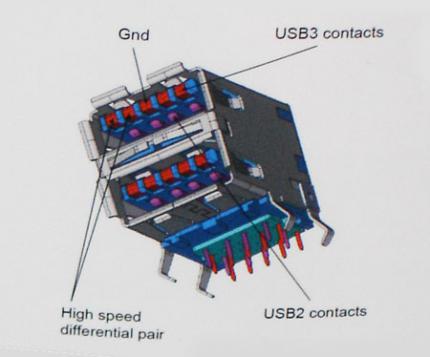
USB3-A receptacles are maybe the worst connector ever invented since the contact area is super tiny and the position of the data line contacts ensure that even vibrations can end up with issues:
I would try to exchange the USB cable first with one that really fits tightly, and if that doesn’t help check power supply situation and here the cable since the problem often is not the amps but voltage drops due to cable diameter too small.
Hi @peromingo,
Did you resolve your problem? I have exactly the same with a fresh raspian install.
Disabling UAS only changed the error message as @tkaiser said.
I haven’t tried with other USB cables yet
The tolerances for the USB bridge and case are very tight. There is a possibility that the bridge is is not making good contact due to being limited by the case/board geometry . You might try the bridge with the case off as an experiment since you can seat it several millimetres deeper. It is a pity that the bridge does not not have more depth on the connectors so that it is fully seated and still has case clearance.
Could replacing the USB bridge help? I have the same problem and my drives disappear at times breaking the RAID. UAS has no affect and I have tried with original and updated JMicron firmware. I also use my laptop power supply that gives more power than the original PSU. It doesn’t matter how many times i try to reset the USb bridge. The problem persists. Anything else I could do?
Hello. I know this is a old post, but I am experiencing the same problem. I thought it was a problem of the raspberry pi (4). Fortunately, I have a replacement but the same issue appears.
I have attached 3x 3.5 HDDs and given their power demands, I am using 96W to power HDDs and pi. However, noticing people with 2.5 HDDs have experienced the same problem, this is making me wonder.
I haven’t updated the firmware bc the link the wiki takes you says to NOT TO DO.
Before investing more money in getting a Pi 5 with a Radxa Penta HAT, I wonder if there’s something that someone has done after the last message (2.5 years ago) to see if this problem can be troubleshooted.
more of JMicron then and more troubles although different (the 64-bit DMA corrupting problem).
This topic and similar was a reason to buy RK3588 instead of BCM2712+RP1. In my case it was a NanoPi-R6C mainly because I had an unused Samsung 970 NVME and the thing also came in nice metal cooling case with OS already pre-installed on eMMC. But I should have gone straight to ROCK5B (or B+ with 2 M.2 slots actually), as I discovered that using ASM1166 6-port SATA and also the RK3588 on-SoC SATA work really great. RPI4 and USB3 is loads of trouble although by powering storage and RPi4 itself separately, I got it stable enough for 24/7 and years operation. I used the watchdog to auto-reset also for some time in other not to have a longer hang of my services (when not home etc).
For 3.5inch HDDs which take anyhow way more power than the ‘CPU’, I never took USB connected really as an option. So just fanless Intel/AMD boards with 2-4 SATA connectors are just fine. Still have a J1900 board with 16GB RAM, runs from 12V. Those might be way cheaper second hand compared to new RPI5 or the various ( virtually sold-out ) other ARM SBCs.
For your RPI4, make sure you have permanent loglevel=7 (it is reset to 3 or 4 by RPi patches/config at startup) , then dumping that on serial console 24/7 will show what the USB stack and associated modules do.
This looks like some connection issue, but same problem was reported on odroid and others. As far as I remember I got it on ROCK 3A also. This is not connection problem it’s software related. There is some incompatibility with some drives. Some work for very long in UAS mode, some only in non-UAS.
There were firmware updates that have known issues, ie. work stable but disconnects once You send certain smart command. You will get broken sata link in that case too.
This one may look similar, but it’s based on different chip. No RAID, but overall it’s much better and more stable.
Turn on internal RAID mode and You will get stable NAS.
Currently, the top I managed to get is about 13 hours, then 2 disks disappear.
As for the internal RAID, I am not using it. I am working with ZFS, which works just fine on a VM or PC. And given its flexibility (eg being able to recover from all the mess of getting 2 drives disconnected at random times without losing a bit), I’d stick with it.
It’s a pity that it cannot work reliably and not my idea to shifting to the penta hat seems also not reliable as I’d expect.
Yes, so it seems 1 big experiment, I remember from more than a 1 decade ago when I thought RAID would help me. Instead more troubles than just keeping HDDs separate as single object and using Btrfs or ZFS send|receive tooling to replicate between them from time to time. So several HDDs can be sort of could storage, for a day or a week or longer, I have kept snapshots (so in a parent -diff replicating situation) for up to a year, nowadays much shorter, it also depends on type of data. TV recordings I do not even CoW/checksum protect (Btrfs nodatasum mount option).
It might be a bit difficult to get a nice and cheap N100 board for example with 4 SATA connector, I remember from 2 or 3 years ago. The market was flooded with miniPC’s, but already pre-integrated just for simple desktop usage like the SBC’s. If you don’t do on the fly compression (zstd:3 or so) a ROCK3A with 1 E-key SATA breakout board works fine once you have done the HW (12V power circuitry). I get about 4 Watt idle with (that is including NVME and HDD(spindown)). NVME is for OS and caching HDD. Just an N100 is 6W idle or so. You also might look for a ROCK3B, might not be sold out and has more and better placed connectors so if you would flash mainline U-Boot to SPI and connect an ASM1166 based M.2 (M-key) module (I got mine for 15Euros), you have 1600Mbps bandwidth in both directions and 6-ports where all should support OS boot as well. So like the old 50 to 100 Watt Intel core i7 motherboards with 6 SATA ports.
Turn it to internal RAID and re-test, with disconnecting drives its not much usable so You have nothing to lose
As far as I know those issues depend on particular drive, some of them are probably working just fine. With RAID You will cover drives and get perfect stability and smart full support. Mine works few years already in RAID mode, current uptime is >2y without disconnecting.