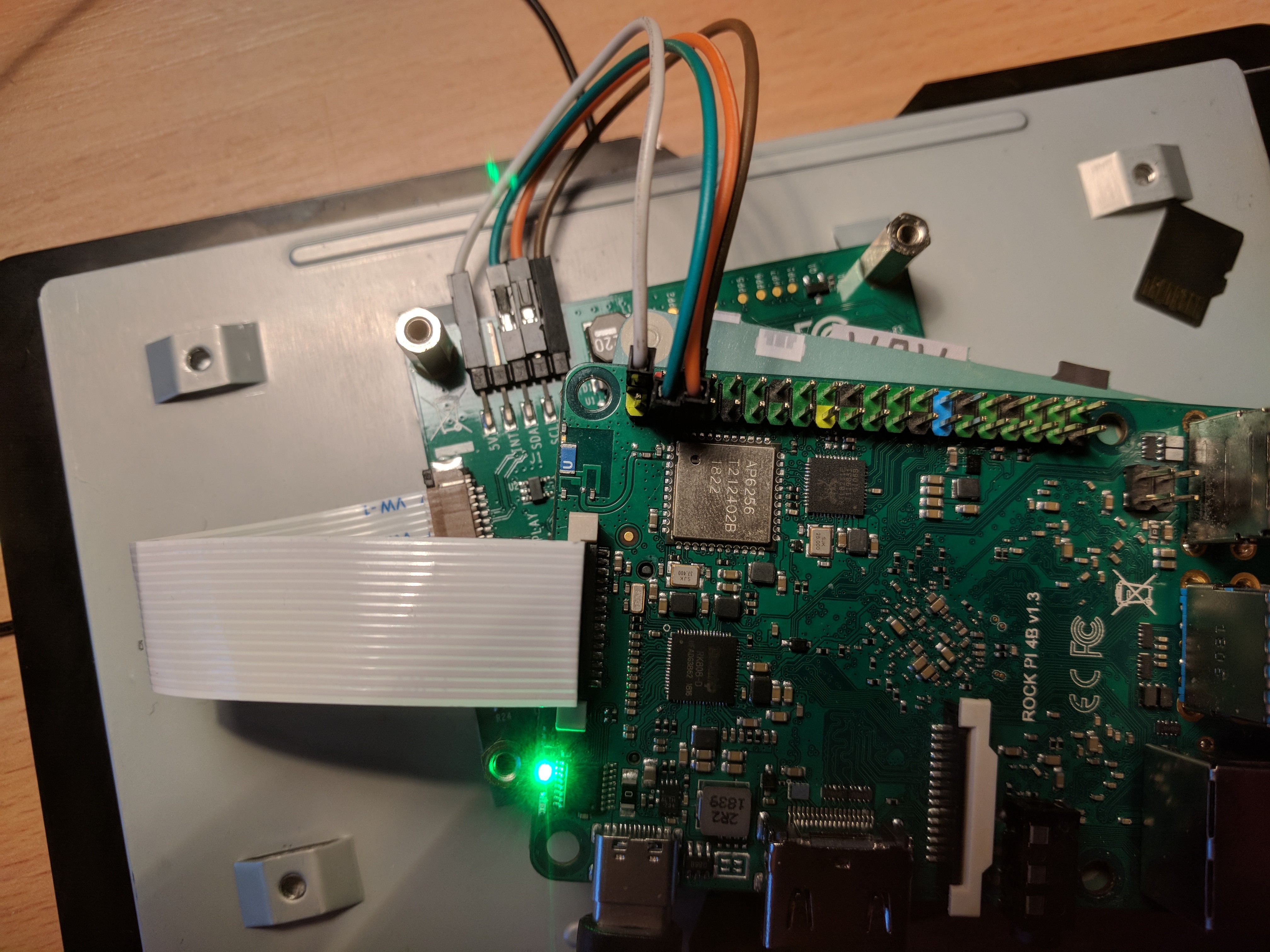
I have some problems with trying to get the official Raspberry Pi Display 7" DSI touchscreen Display to work with the Rock Pi 4B V1.3.
So far I have tried Debian, Ubuntu Server and Android downloaded from your site.
None of my tries were succesfull with getting the display even remotely to work.
Even powering the display directly via micro-usb and disconnecting the cables.
xrandr --output -DSI-1
only gives an error, cant open display.
The Debian image and the Android image(not android tv) should work with the display out of the box. Could you attach a picture of how you connect the display?
I connected the Display like you would on a normal raspberry pi.
5V (white) to the first pin on the right,
GND (brown) to the third pin down on the right hand side,
SDA (green) to the second pin down on the left hand side,
SCL (orange) to the third pin down on the left hand side,
and the ribbon cable to the dsi connector.
But i noticed one thing. Having only the Display connected while plugging in power would light up the Display and after a second or two the Rock would just shut down.
Having the Display and a HDMI Monitor plugged in leads to a normal boot to the desktop without problems. Desktop would show on the HDMI Monitor and a portion of that (800x480 pixel of the upper left corner) on the Display, as expected.
I then added hdmi_force_hotplug=1
to the /boot/config - file
This led to the Rock booting with the Display IF the HDMI Monitor was disconnected, so kinda the other way around.
I also tried my project on the Rock and it works just fine without any issues, I just need a working browser with a kiosk-like mode :).
I’m looking forward to using the Rock for further projects.
Hi Roggerson
i tested my rock board folllow this way only the display connected,the board can boot to the desktop without problem,the whole desktop would show on the display.
and then,i connected the Display and a HDMI Monitor(1920x1080),that’s ok too,the HDMI output 1920x1080 pixel and a portion of that (800x480) on the Display,like yours.
then i pulled out the HDMI cable,the whole desktop would show on the display.
this issue can not reappear, i think you’d better post your dmesg.
I’m relatively new to Linux, and NONE of that worked. “deb” in not a command, “create” is not a command, “/usr/local/sbin/rockpi4b_upgrade_bootloader.sh” cannot be found, etc., etc., etc. NOTHING worked.
Can someone clarify for a Linux noob? Also, there is no /boot/config file to edit.
Hello,
don’t worry about it, we all started and probably many of us had similar problems in the beginning. Now to the Official Raspberry Pi Display. Connecting and setting this up to an original Raspberry Pi is not necessarily suitable for beginners, but there are lots of descriptions and several forums provide answers to questions. Connecting this display to an SBC that offers greatly expanded capabilities due to different hardware base and therefore probably can’t be 100% compatible is far from “suitable for beginners”. But now you are asking for basic Linux knowledge. I think you should learn the basics yourself, there are enough sources.
I’m not a beginner to computers, electronics or single board computers and have used Raspberry Pi’s in the past with success. The issue I was having was following Brian’s instructions. Some of what I thought were Linux commands were instructions from him. I was finally able to follow his instructions and am on the updated firmware now, but the dispay still will not work. The Rock Pi work fine with through HDMI, but if there is a setting to switch displays, I cannot find it. This is all the more confusing with Roggerson’s assertion that he edited the boot/config file, a file that does not exist on the Debian desktop for the Rock Pi. It DOES exist on Raspbian though.
I’ve tried powering the display both through the Rock Pi and through a Micro-USB cable and have the data cable installed correctly. I’m certain this is a configuration issue, but I cannot find the solution. Any search on my part through Google turns up tons of results for the Raspberry Pi and none for the Rock Pi.