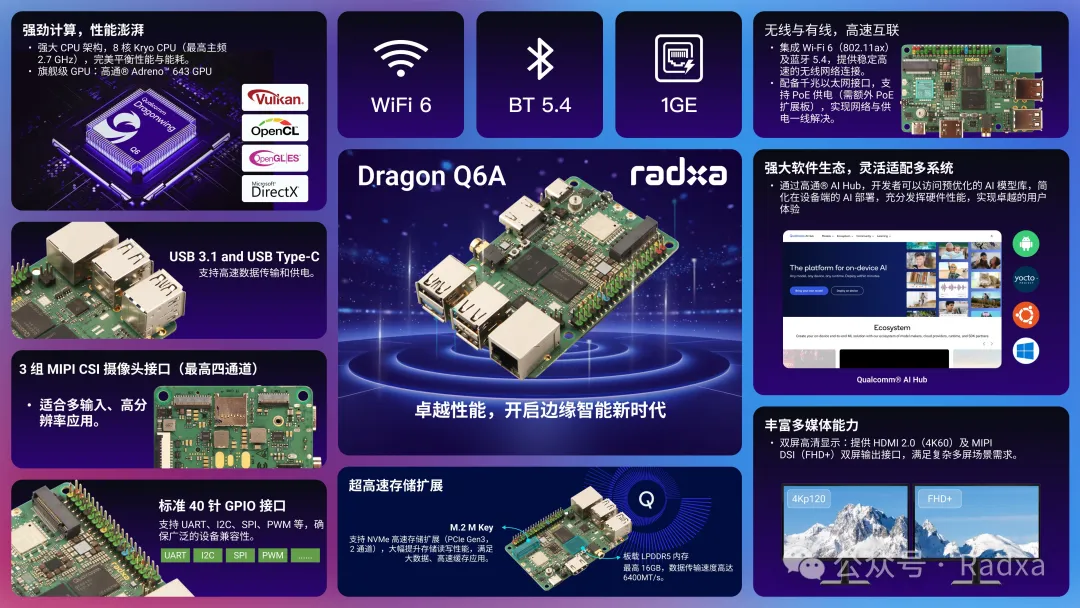
This one I can sadly already answer with no. USB-C is just for power.
I wish they would’ve used the native DP capability of the SoC instead of routing it through the RA620 for HDMI conversion and maybe use MIPI to HDMI for the port
When you check the individual results, you can see that there’s a huge discrepancy between results. I think it would be fair to expect at least 4x from single to multi, due to 4 big and 4 small cores, while the big ones combined deliver a total of 3.6 times the biggest one’s capacity. But some tests like file compression seem to be I/O bound since just about 1.5 times faster in multi-thread. Others are 3 or 4 times faster. We do not really know what is affecting performance this much. It could even be a low frequency DRAM which prevents cores from scaling.
How to ‘improve’ multi performance? Just use the predecessor Geekbench 5 and now your machine ‘performs’ 84 times faster multi vs. single (while more realistic benchmarks like 7-zip’s show a 155:1 ratio which resembles real-world performance more closely). Also just look at the consumption figures (279W GB6 vs. 586W with GB5)
TL;DR: GB6 (on anything other than x86) is a joke but people don’t care
Qcom documentation indicates that the QCS6490 (Snapdragon 782G) has only 2MB of L3 cache. This compares to the 4MB L3 of the competing QCS8250 (Snapdragon 865) and the 3MB L3 of the RK3588, which may be responsible for the lower scaling performance.
The thing that ‘reports performance’ (benchmark) is software and software contains bugs. In GB6’s case it’s long known and pretty obvious that this software uses weird and highly uncommon memory access patterns that do not represent anything happening in the real world.
Why ‘perform’ the four A76 on RPi 5 only two times faster than a single one? Since ‘measured’ by Geekbench 6. Want faster multi performance? Use GB 5 (or any other more realistic benchmark that doesn’t suck too much).
The Raspberry Pi Ltd. people even paid a contractor to hack together a ‘NUMA emulation’ for their kernel which does one single thing: improve GB6 multi performance by a few percent, no other software affected.
Hey! What’s fun with Radxa is that I really learn about new models when opening my mailbox after I get back from work It’s always a bit like Xmas before the date. I first thought it was the components I ordered from Ali that arrived early, until I unpacked everything and stumbled on this:
BTW it’s strange that it’s written “6GB” on the model while valid ones are 2/4/8/16. Probably that it’s 16 and the 1 wasn’t printed. I’m afraid I’ll have to wait a bit before testing it, I’m quite busy at the moment and next week is kernel recipes. Will probably check on the next week-end. Thanks to the team!
Hmm at first I was a bit confused by the “16 bit” width mentioned above. I checked the schematic, and it’s a dual-channel 16b (thus 32 total). I couldn’t find any reference for the marking on the board (CG439005200A0). I could imagine it would be a 6400 MT/s since it’s what the SoC supports. But indeed, if yours detects 6GB, that should be it. It’s just surprising since not listed on the list of optional sizes on the box. Maybe that’s the size chosen for the early models.
Edit: the spec here mentions “4GB / 6GB / 8GB / 12GB / 16GB” as the DRAM options, so it’s just the printing on the box’s bottom that’s not up to date.
The 6GB and 12GB model was added later when we found that at this size it would be a price/volume sweet point. The dram is running at 5500MT/s at the moment.
I actually care a lot about your insight. To answer your question if I am not worried about the performance results: At least not yet but I also only was doing only a first look. I’m planning to do a proper bench with your sbc-bench too as well as go more in depth in the full review. For why I am not worried is that the chip seems to be more power efficient or restricted than other Quad A78+A55 chips so my numbers were only early results with one benchmark that is only there to have a number at all.
I might not be able to squeeze every % point of performance out of it but I will try to provide a allround solid armbian experience while always being open for suggestions. (I still plan to incorporate your suggestions which were wrongfully dismissed for RK3588 someday too)

 It’s always a bit like Xmas before the date. I first thought it was the components I ordered from Ali that arrived early, until I unpacked everything and stumbled on this: