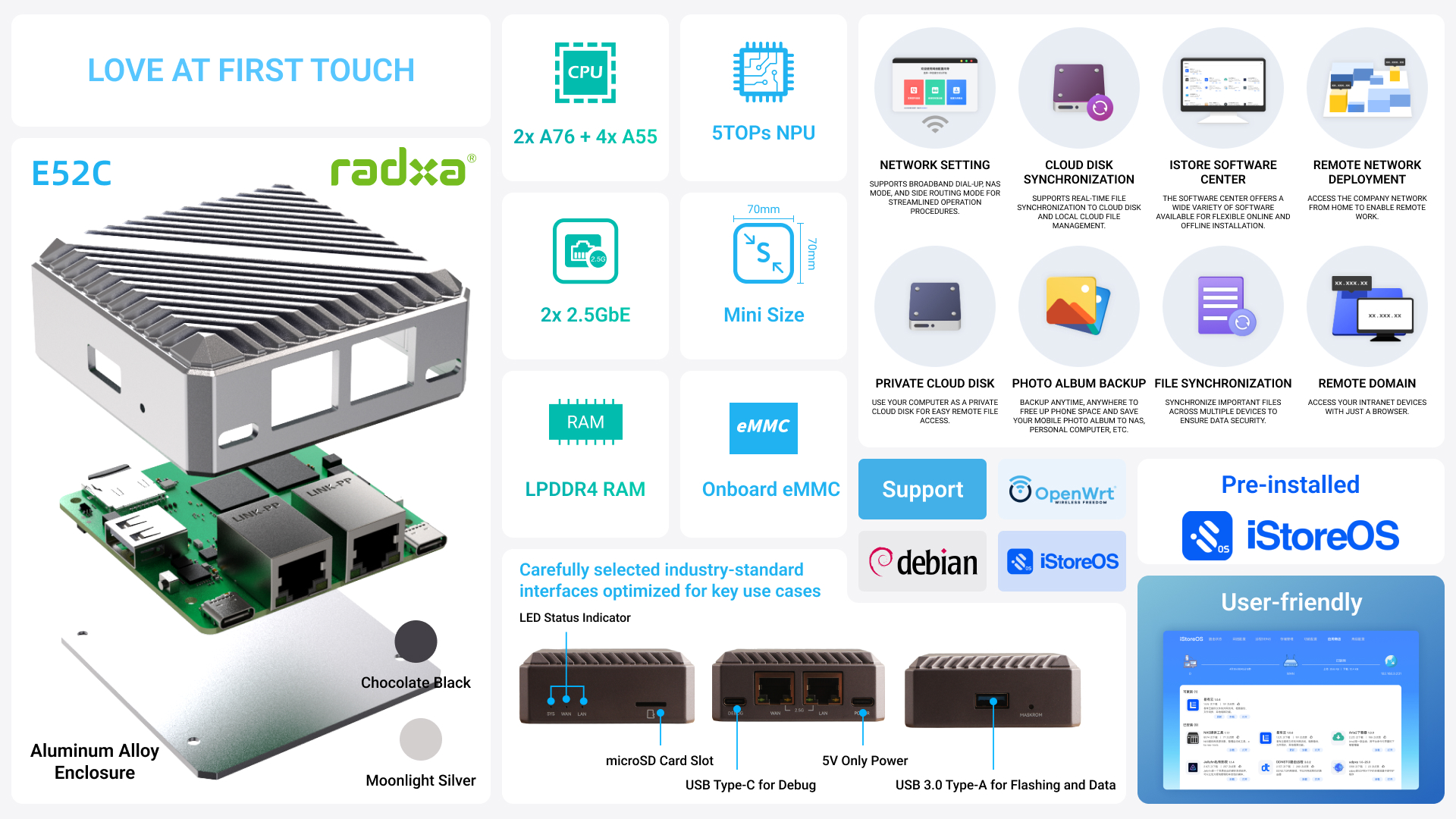
I am glad to introduce E52C, a dual 2.5G router based on RK3582, and upgrade for E20C.
Since launching E20C during June, we’ve gained widespread market recognition and trust through exquisite craftsmanship and outstanding performance. Now, E52C inherits the classic DNA while achieving quantum leaps in core performance:
Finally something looking like what I need: dual-2.5G AND debug port.
Does anyone have an idea about the current state of mainline kernel support ? Last time I tried to boot the rock 5 itx on 6.11-rc4, it would still hang during device detection and I couldn’t make any progress since then. It would be nice if 6.12 would finally support basic stuff (console, storage, network) since it’s likely to become LTS.
I also was interested in such debug port This will help a lot for me, as I understand this will work exactly like UART adapter plugged into usb? Will this be able to power up device?
Other interesting thing is iStoreOS, this seems to be openWRT fork with prepared services as well as modern, eye-candy interface. But.. why there is no English version available? This looks like chinese only product No English version, so only auto translated.
This is probably some early prototype? With typo in usb-C ports and holes for Wifi antennas?
Wireless is missing here with this device. At least one wireless card would help a lot, to connect device in hotel/as guest and spread signal where it’s needed. With two wireless devices we could connect to untrusted wifi and broadcast own wifi. With wifi monitor mode more interesting things are possible. One usb port can be used for one wifi card here.
edit: what about usb-c 5V only port? Will this one be ok with 5V2A? Maybe 5V3A? or should it has something like pi5 - 5V5A?
So this DTS-only work alone is sufficient ? Great to hear! I expected more work to be needed given that I never managed to get my Rock5 ITX even close to boot (hangs after a few tens of lines during device detection).
Thank you Naoki. For me u-boot is not as much important as the kernel. I can leave with a patched u-boot as it doesn’t affect my system’s stability once it manages to boot. However I can understand how it can be problematic for kernel developers (had to deal with that long ago on other devices).
But yeah, being free to build a mainline kernel with the options I need/want and not just the few combinations that don’t break the build (as is common in BSPs) and being free to apply fixes is important to me
It would have been perfect if it has a m.2 B-keyed slot for 4G / 5G modem (need both USB and PCIe) while others may also use adapter to put 2230 SSDs or WiFi to the slot if they wanna
Sure, but according to the datasheet, there are only two pcie lanes max on the SoC, which are both taken by the network. It’s clear that general purpose SoCs are still severely lacking I/Os, but compared to what it was 5 years ago where it was already hard to have even a single lane, vendors are making progress. We’re still far from marvell/NXP chips but they target a different market!
Two pcie lanes are perfectly ok, but current design forces to use those at only one thing at time. We should get pcie switches that should downstream more ports and automatically divide data bandwidth between all devices. Usually nvme and network nic are not used at same time, we could get fast startup and network.
Of course pcie switch chips are rather expensive, I could not find any HAT for pi5 with pcie gen3 chip yet, there are many gen2
Probably for such device it would be easier and cheaper to just use RK3588 with its 4x pcie 3.0. Basically something like small ROCK 5B+ with most ports stripped. Opi 5max was smaller and still has one m.2 with 2280 and all video input/output. Hard but probably possible to make it even smaller
My concern about PCIe switches is also their price. Last time I checked, the few I found (ASM-something) were more expensive than the difference between a low-end and a high-end SoC :-/ I think that some chip vendor should realize that there’s a market here and just like some specialized in making cheap ubiquitous ethernet PHYs, some should probably work on cheap gen2/3 switches allowing to easily split 1/2 lanes into a total of 4 that could be bifurcated as desired. If that chip was small (less than 1 sq cm) and a few bucks, it could probably easily be placed on many boards. And there’s a market for these due to M.2 which requires more lanes and forces some abitration at the design phase. Even in PC motherboards you have to choose between less PCIe slots and more M.2 or the opposite. With a PCIe switch it would no longer be the case (though at PCIe 5 speeds and x16 that wouldn’t be the same cost ;-)).
pex8725 looks promising, it’s gen3 pcie switch chip, right now priced at $140 (+10) but was available earlier for $125. This is still quite expensive, but it should cover everything that is needed. I should have such card soon paired with two ACQ113 chips and with two m.2 ports. I hope it will work on Rock 5B:)
Right now this is level of pcie gen 2 switch chips We will not see cheap gen3 switches with more than 1 upstream port.
For now on PC You can just add big pcie card with it’s cooling. On SBC we will not get anything like that until something cheap, small, cold would be released.
Yep, it is pretty sad that there’s only 2 lanes available, 3 will do already. For RK3582 based E52C, maybe a variant of SoC GbE (WAN) + 2.5GbE (LAN) instead of 2x2.5GbE? 2.5GbE switches are way cheaper now and I think 2.5GbE internet should still be quite expensive, so it could be a viable option? There could be some processing power for something else as well.
I hope the next SoC could have PCIe 3.0 on all lanes, as PCIe 2.0 is really not sufficient these days, given that 5G (~7.5Gbps) and WiFi 7 @2T2R (around 4.5Gbps) can use more than what PCIe 2.0 x1 could provide (4Gbps) already, and perhaps the SoC may also comes with on-chip 2.5GbE (max GPON speed) instead of GbE, then 2 PCIe 3.0 lanes would still “work”, though I guess 4 lanes would be best such that ppl can either put more NIC ports or a PCIe 3.0 x2 SSD on it.
PCIe switch… the cheapest one is like ASM1182e which is PCIe 2.1 x1 to 2x1 at ~US$5? but that won’t really do much. Anything above (eg x2 to 4x1) would be rather expensive, so it may be better to have the switch built into SoC = SoC provides more lanes instead… I don’t think ASM2806 (PCIe 3.0 x2 to 4x1) is that cheap, should be in US$20~US$30 range? really not familiar with these component pricing, just say what I can see via searching with Google.

 Hail to Rad@xa!
 This will help a lot for me, as I understand this will work exactly like UART adapter plugged into usb? Will this be able to power up device?
 No English version, so only auto translated.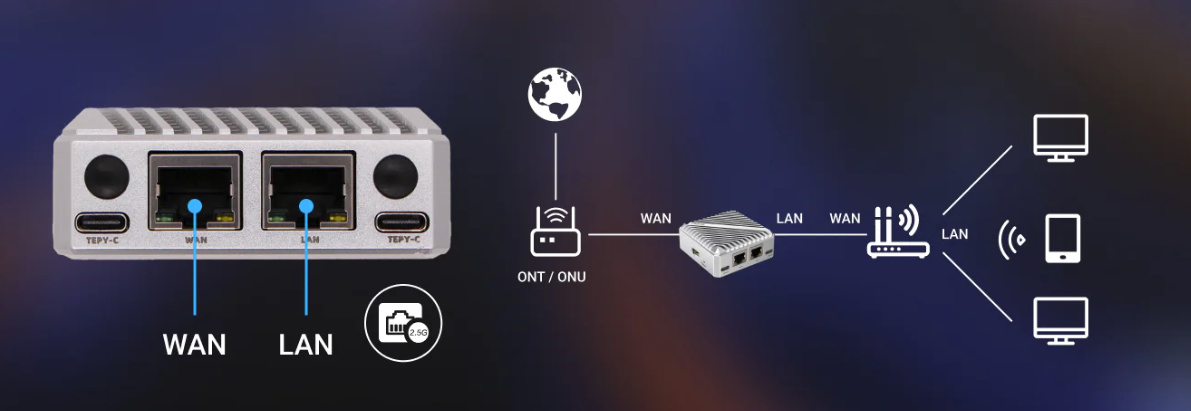

 We will not see cheap gen3 switches with more than 1 upstream port.