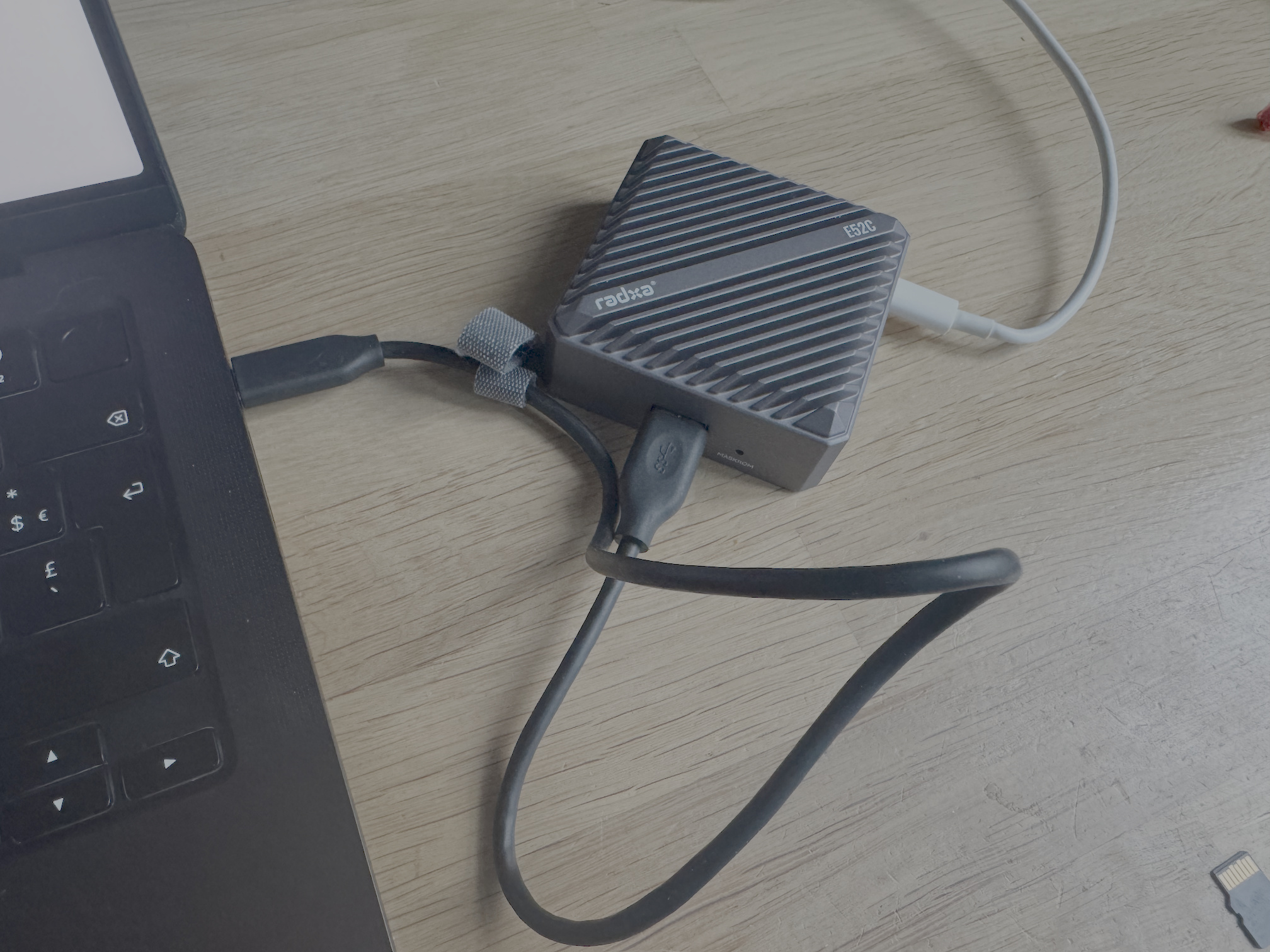
The device won’t provide an IP anymore and the led on the NIC won’t flash. Did I brick it? The documentation is very low as to what to do so any help would be very much appreciated.
Thanks. I tried to do that but I can’t manage to get it working. I am on MacOS, built rkdeveloptool
and followed the instructions.
sudo rkdeveloptool ld returns not found any devices!.
I am using a USB-A to USB-C cable from a portable SSD. When I connect it on my mac it takes power from that link so it seems to recognize it but lsusb -v shows nothing.
When I plug the power, the led sys led is immediately green, does not blink.
I also tried to flash a MicroSD card with the iStoreOS but nothing seems to be happening. I was hoping it would recognize that and boot from there but it doesn’t seem to do anything with it.
I have no idea. I can connect to the debug port if I just put the power and connect the debug port to my mac. I am happy to provide more details if you tell me which command output you’d like to see.
I have non blinking sys, nothing on wan/lan both on the front and the back.
Can you please be a bit more explicit? I already said that maskrom with rkdeveloptool does not work. The only thing that works is power + debug port and picocom.
If you start your serial terminal before powering it on, start to capture, then turn the power on, I suspect you’ll see the DDR training, then u-boot, then it’ll load the kernel and initrd then possibly hang without saying anything. Or maybe u-boot will complain that it doesn’t find a bootable kernel image. Or maybe you’ll see an early boot and a crash or some errors. All of this gives information about what the problem is. Also normally you can interrupt u-boot by pressing Esc or Ctrl-C when it prompts you to do so (that probably lasts a single second during boot). From there it’s possible to boot from other devices (I don’t remember exactly, it should be “run bootcmd_mmc0” or “run bootcmd mmc1” or “run bootcmd_usb0” depending where you want to boot from.
So that means that you’ve probably ruined your kernel image and/or the boot.scr file.
You’ll need to press Ctrl-C when it suggests it and to try other commands like above.
Most likely it will be easier to dump a valid image on a micro-SD and try to boot from it
using one of the “run bootcmd*” commands above.
I did dump an image on a micro-SD card and it’s supposed to boot from it but the SD-card slot on this device is really weird. When I push the card in the slot, it bounces and does not seem to be fully inserted.
The tool does report it didn’t find it as well:
MMC: no card present
mmc_init: -123, time 0
switch to partitions #0, OK
mmc0(part 0) is current device
Scanning mmc 0:1...
@ChenJaly is this normal? I was expecting the card to not bounce in the SD slot.
Ah yeah I already noticed that you need to install the SD deep into the slot. I used another one to push it fully and hear the click. Once it stands by itself it’s OK, otherwise it’s not. You’ll need another card to push it again till the click if you want to remove it.